mod30-residue-lanes / lab report
Notebook 01 — Symmetric Equilibrium in Residue Space
Foundational baseline analysis for the eight admissible modulo-30 residue lanes:
01 → 07 → 11 → 13 → 17 → 19 → 23 → 29
Overview
Notebook 01 establishes the symmetric baseline for the mod30 residue-lane manifold.
Before adding prime filtering, rolling drift, boundary pressure, graph embeddings, or sparse reset events, the repo first verifies that the eight admissible residue lanes form a balanced substrate.
01, 07, 11, 13, 17, 19, 23, 29
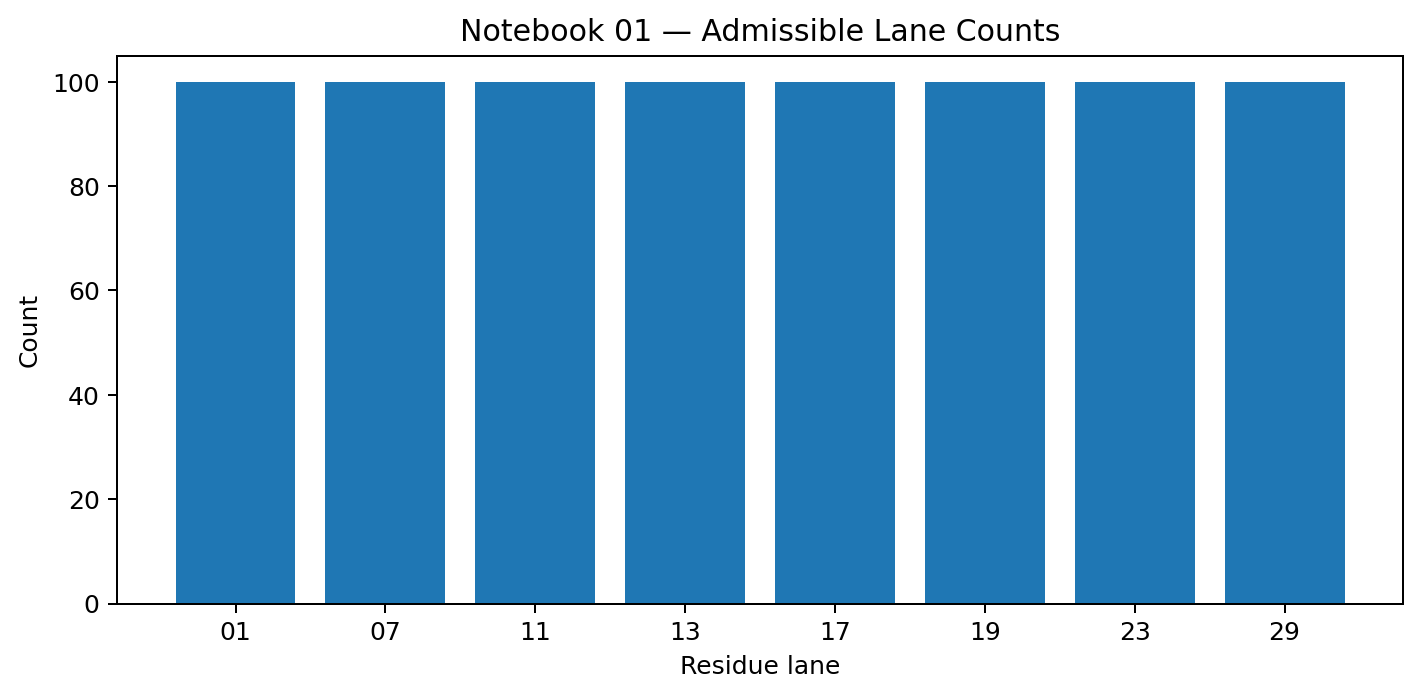
This notebook demonstrates that complete modulo-30 cycles produce equal admissible-lane counts. That equilibrium result becomes the reference state for every later notebook.
Core Features
| Feature | Description |
|---|---|
lane_01 |
Anchor residue lane used to establish the first baseline comparison. |
admissible_lane_counts |
Counts across the eight residue lanes coprime to 30. |
lane01_spacing |
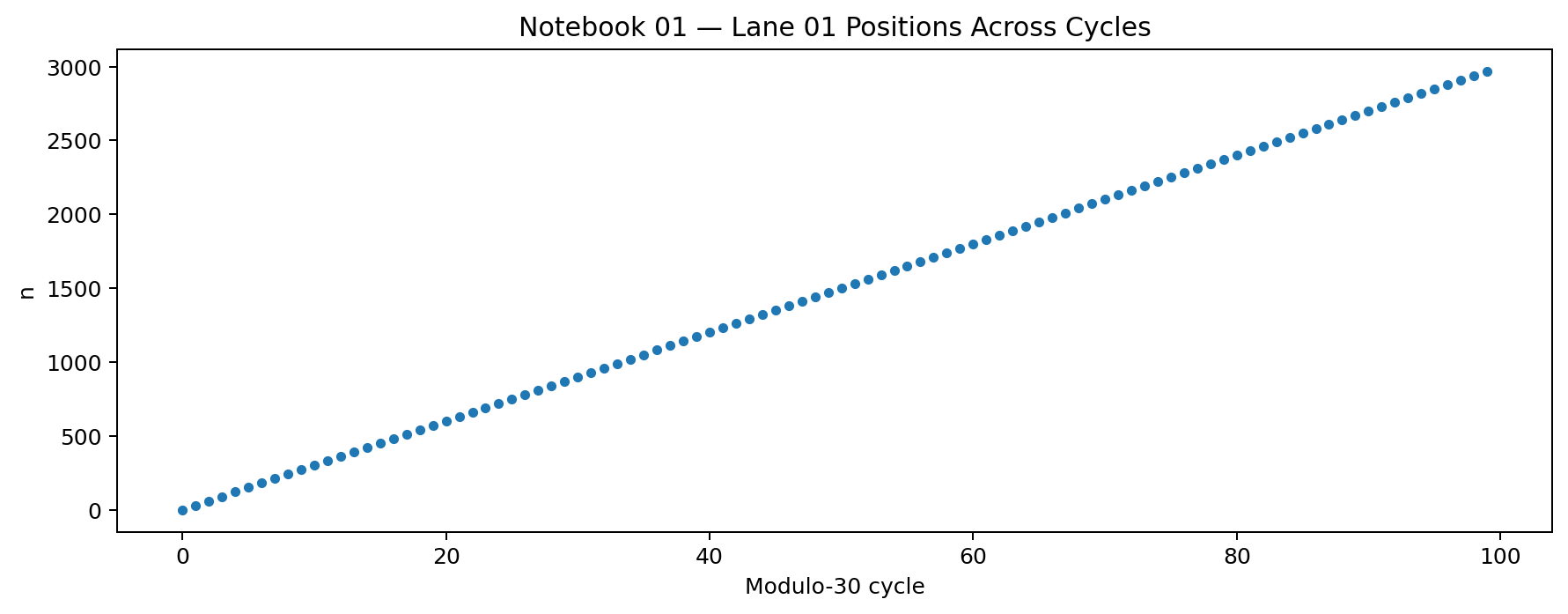
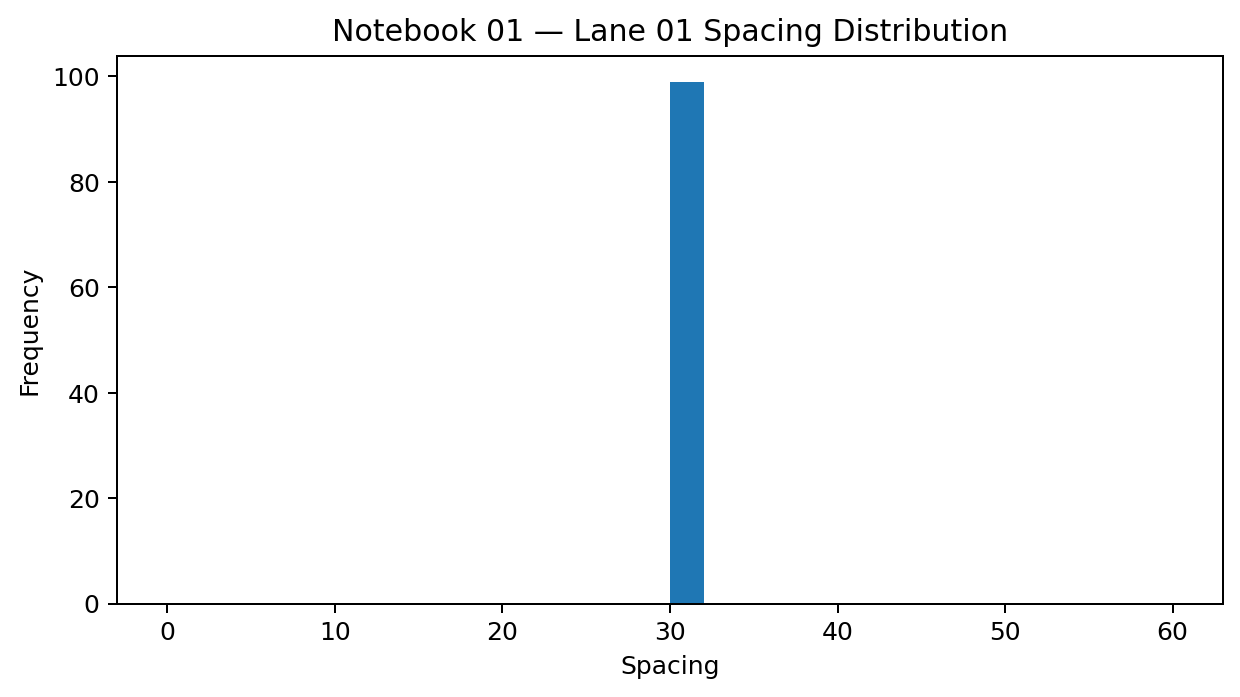
Spacing between repeated lane-01 occurrences in complete modulo cycles. |
window_lane_vectors |
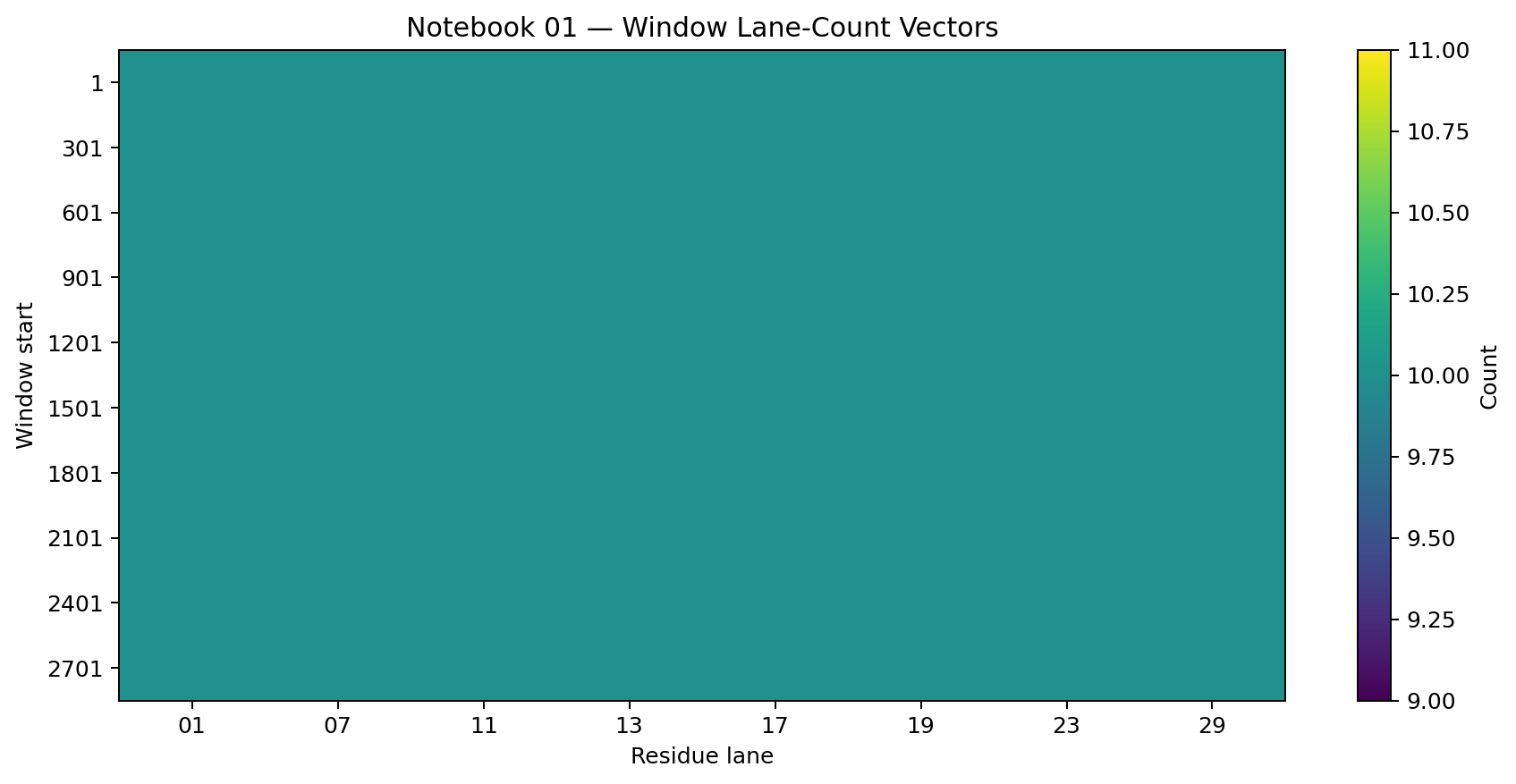
Eight-lane count vectors used as reusable manifold-state representations. |
lane01_similarity |
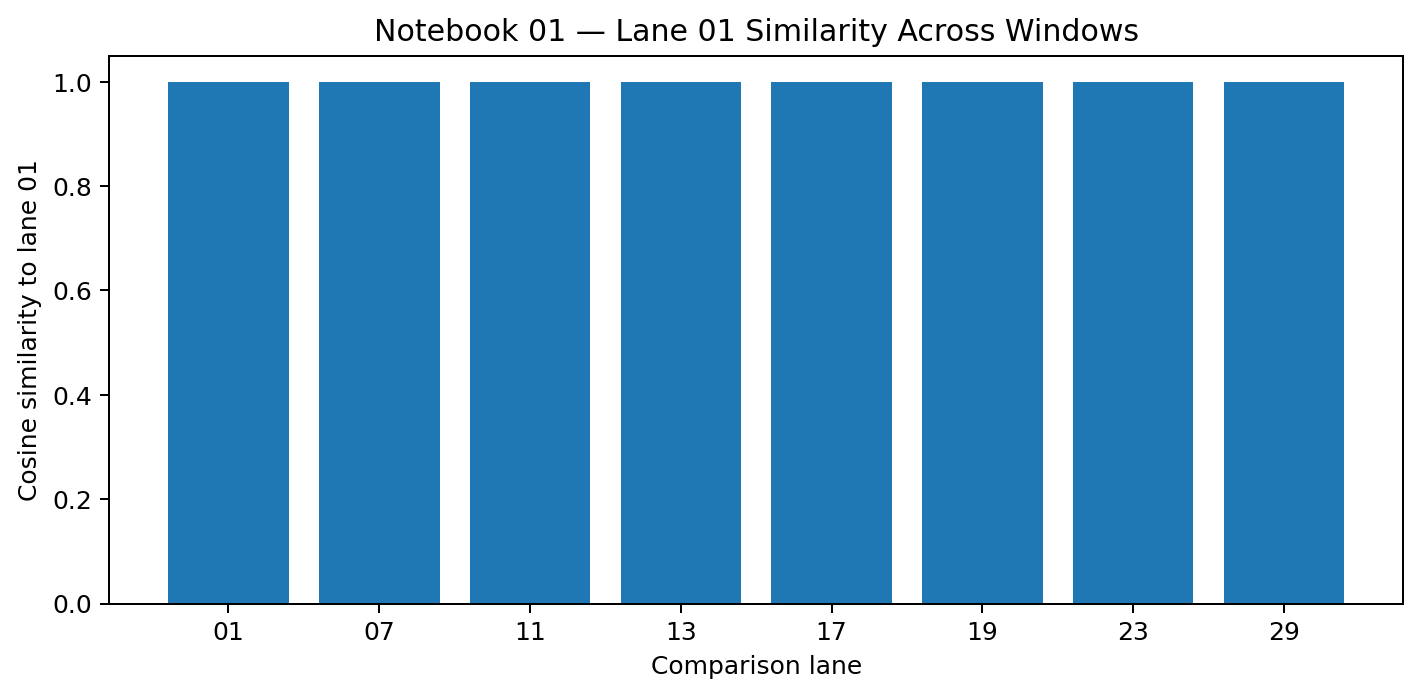
Cosine similarity between lane 01 and all other admissible lanes. |
Admissible Lane Counts
Lane 01 Positions Across Cycles
Lane 01 Spacing Distribution
Window Lane Vectors
Lane 01 Similarity
Interpretation
Notebook 01 is intentionally calm.
The point is not to find instability immediately. The point is to establish an equilibrium state: a balanced eight-lane residue manifold before additional constraints are introduced.
- Lane counts remain uniform.
- Lane 01 spacing remains fixed.
- Window vectors remain stable.
- Cosine similarity remains maximal under symmetric sampling.
Later notebooks become meaningful because Notebook 01 defines the baseline that they break, bend, rotate, or sparsify.
Relationship to Later Notebooks
Notebook 01 establishes:
- the admissible lane substrate,
- the symmetric count baseline,
- the first lane-vector representation,
- and the anchor state for later comparisons.
Notebook 07 then introduces the first major departure from this equilibrium by adding prime filtering. Later notebooks extend the sequence into rolling drift, boundary pressure, spectral decomposition, graph embeddings, and sparse reset-boundary emergence.