arXiv:2508.13356 · SiV spin qubits · mechanical coherence protection
From Protected Coherence to Gate Pathways
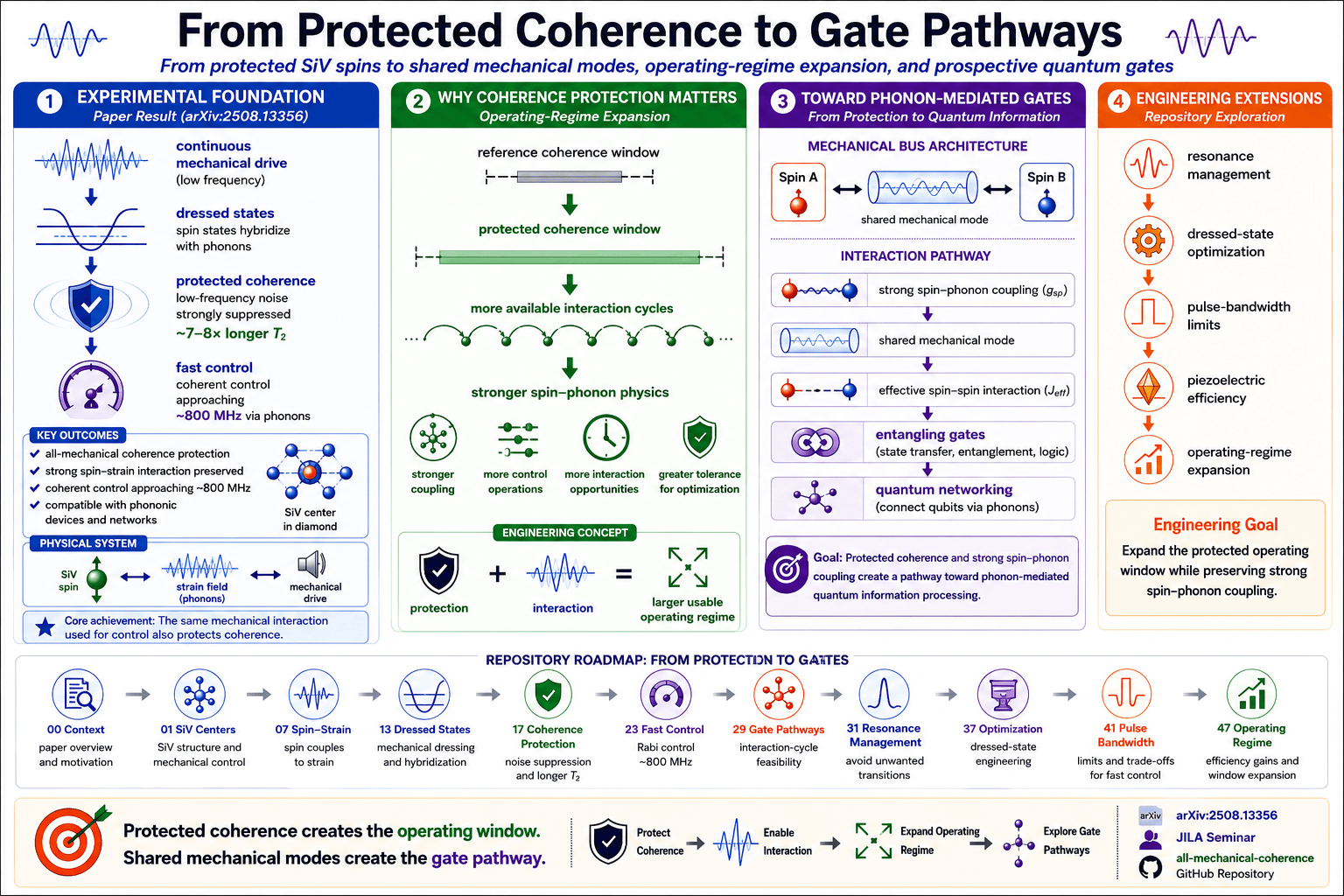
Continuous mechanical driving can protect and control silicon-vacancy spin qubits. This report extends that result into a repository roadmap: protected coherence creates the operating window; shared mechanical modes create the gate pathway.
Core claim
Continuous mechanical driving creates dressed spin states that suppress low-frequency magnetic noise while preserving strong spin-strain control. That protected coherence becomes an engineering resource: it expands the time window for interaction, resonance management, and future mechanically mediated gates.
\( \text{available interaction cycles} \sim T_{\mathrm{coherence}}\,g_{\mathrm{spin\text{-}phonon}} \)
Experimental foundation
Mechanical dressing hybridizes spin states with phonons, creating protected dressed states while preserving fast coherent control through spin-strain coupling.
Operating-regime expansion
Protected coherence increases the usable interaction window, allowing more control operations and more opportunities for spin-phonon dynamics before decoherence dominates.
Gate pathway
Shared mechanical modes provide a route from protected spin coherence to effective spin-spin interaction, entangling gates, and phonon-mediated quantum information processing.
Repository roadmap
The repository extends the paper into an engineering sequence:
mechanical drive → dressed states → coherence protection → fast control → resonance management → shared mechanical modes → gate pathways
Engineering statement
Protected coherence creates the operating window. Shared mechanical modes create the gate pathway. The next engineering task is to optimize dressed-state splitting, pulse bandwidth, resonance conditions, and piezoelectric efficiency while preserving controllable spin-phonon interaction.